

A peek at the Reek’s new path

Intrigued by plans for a new path on Croagh Patrick, the BBC’s Tracey Logan travelled to Mayo to report
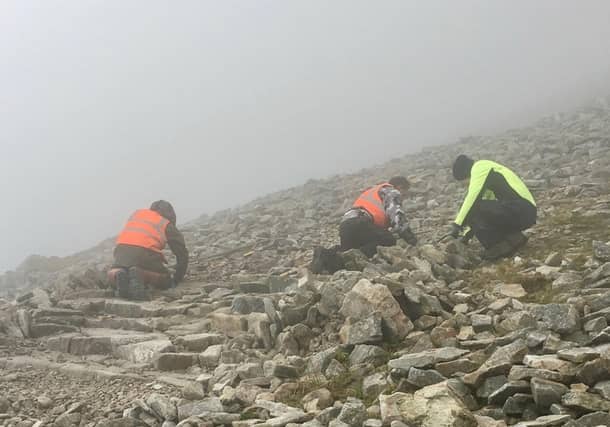
STEPPING OUT Mark O’Brien, Matt McConway and Martin Keating laying the trial path near the summit. Pic: Tracey Logan
Intrigued by plans for a new path on Croagh Patrick, the BBC’s Tracey Logan took to the Reek this month to report on experimental new paving there
As the granddaughter of a Westport man and frequent visitor to the town, I am as obsessed with the Reek as any ‘blow-in’ can be. And almost everyone seems worried about erosion to its path.
Local priest Fr Charlie McDonnell describes it as looking like ‘a massive scar which almost looks like a hole, from a distance, on the side of the mountain’. I’ve checked on Google Earth and passing airline passengers could definitely view it from their window seats. So, it was great to read Áine Ryan’s report in The Mayo News last August that a new trial path was to be tested as a way to stop further damage.
But could a new path feel as authentic as walking directly on the mountain, I wondered? Would pilgrims still feel in contact with the footsteps of St Patrick? These were the questions I sought answers to in my report for the BBC’s Sunday programme.
“I don’t think St Patrick was spending his time walking up and down the mountain,” said SiobhΡn Garrigan, Professor of Theology at Trinity College Dublin, who lives on the shores of Clew Bay and has been climbing the Reek all her life.
“I think the sort of ‘we’ve got to get to the summit and then we’ll have achieved something’ idea is modern and not a Celtic spirituality thing. St Patrick was probably having a wilderness experience on the mountain, seeing it as a place of retreat and contemplation. I can almost guarantee he wasn’t hoofing it up and down every day,” she added.
In designing the new path, the Croagh Patrick Stakeholders Group agreed that it should look natural and use materials available on the mountain. Conservation plans were ‘to put the mountain first’ I was told. Fr Charlie McDonnell represents the local Westport Catholic parish which is custodian of Croagh Patrick’s summit chapel.
“The easiest thing in the world would be to start bringing in helicopters onto the mountain and pouring mass concrete onto it. That’s not going to happen,” he said.
Plans for the path
To find out what was going to happen, I climbed the Reek in early October with an appointment to meet Mayo County Council’s Martin Keating, Chair of the Stakeholder’s Group. It was the day after work began on the trial path; the day before Storm Duncan struck.
Reaching Croagh Patrick’s shoulder I found the mountain to be as ‘hostile and shelterless’ as climbers found it a century ago, when the modern pilgrimage was revived. Strong winds struck me as I stumbled through cloud towards the steep summit cone and at times I thought I’d have to crawl on my hands and knees to keep going. But at last there was Martin, distinctive through the mists in his neon yellow jacket, helping the Scottish upland path builder Matt McConway of Upland Access Ltd, and assistant Mark O’Brien, to lay the first stones.
Martin estimated it would take ten days on the summit cone to build a stretch of 12-15 metres long path. In the event, with a couple of extra days, the team managed two stretches of 40 metres; one near the summit and a second near the foot of the mountain, after the gate. It had only been possible, Martin explained, thanks to the number and enthusiasm of volunteers. Their paths will inform future plans. “We expect to go to the public consultation process in the week beginning November 5,” said Martin.
Pilgrims can’t yet climb these paths. They are built to test an experimental design proposed by Chris York of Walking the Talk (a UK-based consultant specialising in upland path repair and management). To cope with the mountain’s high volume of climbers, more than 20,000 on Reek Sunday this year, the 1.5-2 metres path is nearly twice as wide as most Scottish mountain paths, he said. Hopes are that it will be so much more comfortable to climb than the current, degraded path, that people will automatically stay on it. This would help to conserve the mountain and protect boglands next to it from future erosion.
Unlike the paths used by climbers today, the trial paths are following traditional pilgrim routes indicated on nineteenth and early twentieth century maps. Fr Charlie said that ‘pilgrims for the last 10 or 20 years, who’ve been going up on the bog, will now for the first time be actually going on the traditional path itself’. And this way, he hopes, the bog will suffer less damage in future.
Roman reflections
The trial path uses a technique called pitched cobblestone, where scree rocks found on the Reek are shaped and embedded in the ground ‘like a loaf of bread or a brick on its end’, Chris York explained. Usually, he told me, such paths are built on mountains as ramps. But on Croagh Patrick’s summit cone the slope is too steep for that. So Matt McConway has adapted the technique, adding low steps and flat resting places along the way. He told me this ‘stone pitching’ technique was invented by the Romans, which set my pulse racing. St Patrick was born in post-Roman Britain. Was it just possible that, if alive today he might find the new path familiar? Who better to ask than the Massachusetts-based Roman paving expert Eric Poehler, author of The Traffic Systems of Pompeii?
“Cobbles are rare but known in a few urban places, eg early Pompeii … If pressed, I would say the technique is likely one known at the time [of St Patrick] and possibly one associated with Romans, though almost certainly not built by one.”
What will Croagh Patrick’s climbers make of these new paths, if funding and planning permission is granted to build them for real? Chris York predicts that pilgrims will like them, but what about sporting hill climbers?
“Some like to descend very rapidly on loose scree, almost like surfing,” he said. “That technique of descent won’t be possible on the repaired path, so those who are not skilled runners might find it harder on their knees as the rocks won’t move – some of them won’t like that, but some will.
“The people who are currently sliding on their backsides on their descent, from fear of rocks moving beneath their feet, will have a stable surface to walk down … The consequence for both groups is that accidents might be less likely, but it is not going to make the climb easy.”
But is struggle, after all, a key part of the penitential aspect of pilgrimage on Croagh Patrick?
“Not at all,” says SiobhΡn Garrigan. “The idea that the more dangerous it is, the more hardcore your penance… has nothing to do with God. If it’s penitence you’re doing, if it’s forgiveness you want, you shouldn’t have to risk falling off a cliff to earn it. You get it simply because it’s there.”
On that early October morning when I met Martin Keating on the summit cone, he told me that efforts to conserve the Reek were causing people ‘[to] understand more fully the treasure that we have. And I think you probably would agree that you cannot but be moved when you’re on the mountain. It is a very special place’. Amen to that!
To listen to Tracey Logan’s report for BBC Radio, go to https://www.bbc.co.uk/sounds/play/p06pg57y