

‘A day I won’t forget’
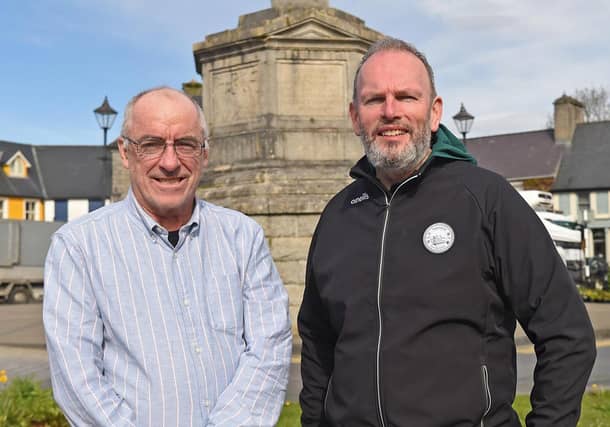

Michael Gallagher
Like his people before him, he left Tullaghbawn and took the emigrant trail in the early eighties. The road out through Louisburgh had seen many thousands leave home behind over the centuries and Ciarán Staunton’s going was no different. However, the man with a savage love of place, would have a major impact on the shaping our history from beyond the seas.
Of course, like all who find themselves in history’s eye, Staunton doesn’t realise the impact he had on the Irish story at home and abroad. He was part of the movement which saw more than 60,000 Irish obtain US visas in the eighties. He was instrumental in Gerry Adams receiving a 48-hour visa to America in 1994, which kick-started the road to peace. He was with republican leader Joe Cahill when he toured America urging acceptance of the Peace Process before the Good Friday Agreement was signed and he now believes a wonderful future is within reach for all the people on the island of Ireland.
Staunton’s early years in America were at a time when thousands of his country men and women flooded into New York and other cities in search of a better life.
“I was bartending in Dorchester and every day of the week there were gangs of people arriving. The space under the jukebox in the corner would be full of cases and luggage every night and you’d be saying, ‘Will you put up these few lads or these few women for a few nights on the couch’.
“Some people would have relations to come to, others wouldn’t so everyone helped out and helped as much as we could. At the time, the Irish Government didn’t want to know about us. They just turned their backs – it was ‘out of sight, out of mind’.”
Staunton and his friends decided to do something about it and tireless work first yielded the Donnelly Visas and followed up with the Morrison Visas to give thousands of Irish a stable life across the sea.
Staunch Republican
The Louisburgh man has always been a staunch Republican and became an integral part of the Irish American movement driving for a settlement to The Troubles and eventual Irish unity. The support of Irish America was crucial in bringing the issue to the fore internationally, according to Staunton.
“The old Garrett Fitzgerald approach of any mention of human rights helping the Provisionals was trotted out for years. Whenever he got an opportunity to speak to the Americans, instead of addressing issues such as plastic-bullets, non-jury trials and human rights violations, he would talk about the ‘men of violence’. Christy Moore sang ‘Though its ninety miles from Dublin, it seems so far away, it’s like we’re getting more support from the USA’, and he was right.
“We brought all those campaigns to Washington despite the Department of Foreign Affairs constantly telling people to stay away from us. It was frustrating but we wouldn’t walk away from it, how could we? Our people were being ruled by tyranny.
“We must remember if the British had held onto Connacht instead of Ulster, Long Kesh and the H Blocks would be in Westport of Castlebar or Ballina. The farmers sons and daughters from Armagh or Tyrone involved in the campaign in the North were the same as the farmers sons and daughters involved in the campaign here in 1919.”
As time passed, things began to change and when Albert Reynolds was appointed Taoiseach in Ireland, the Irish Americans saw a glimmer of hope.
“Albert Reynolds was crucial. He looked at the bigger picture. People were talking about it being ‘the right time’ but that wasn’t the case. We always had the right time, now we had the right men.”
Then, in 1994, Sinn Féin leader Gerry Adams was granted a 48-hour visa to visit America and Staunton was at the very centre of the pivotal moment.
‘Absolutely crucial’
“It was absolutely crucial. Up to then he was being talked about as a man of violence, a godfather – all that sort of stuff. We knew what we had to do was put him on national TV all across the States. I rang the Larry King Show the night before he landed in New York and when he touched down we drove him straight to the studios. The following morning, he was on Good Morning America and all those shows.
“Our priority was for people to see the man for what he really was. When he went on Larry King, Larry began the show by saying ‘This man’s voice cannot be heard on TV in Ireland or Britain. His words have to be voiced by an actor’.
“That showed the madness of what the Government had been doing back at home.
“The Peace Process began to move forward from there with John Hume and Adams meeting despite a lot of criticism. Republicans were giving their backing to it but the process wasn’t without pitfalls.
“Albert (Reynolds) was removed as Taoiseach and the whole thing was left hanging there. John Bruton was an absolute disaster for the Peace Process. There was nothing happening and the efforts people had made were being ignored.
“Then Canary Wharf (bombing) occurred and it looked bleak for a while, but Bertie (Ahern) came in, the Republican leadership stayed with it and worked night and day to get it back on track. There was a commitment then from Dublin and London that the same mistake wouldn’t be made again and within a matter of months talks began in real fashion.
“There were many detours along the way. Gerry Adams, Martin McGuinness, Pat Doherty and many others brought their people with them. John Hume stayed with it, Martin McGuinness worked closely with Seamus Mallon, great men in the Department of Foreign Affairs like Seán Ó hUigunn from Tourmakeady will never get the credit he deserves what he did in those times.”
Those efforts eventually brought about the Good Friday Agreement and changed the course of Irish history forever. As the deal was signed, Staunton was in Manhattan in his newly opened pub, O’Neills, celebrating the moment with family and friends.
“It was a day I won’t forget. It isn’t perfect and isn’t a final solution to anything but it has put us on course to a great future where unity is close at hand because people held their nerve when all seemed lost.
“How many people are alive today who wouldn’t be alive without that Agreement? How many people have been born since that know nothing about what went before? The future is full of opportunities now.”